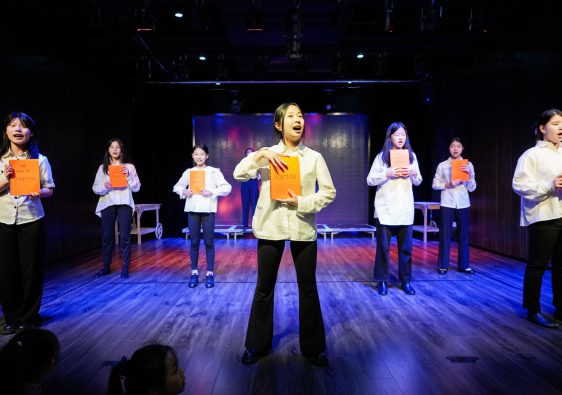
The “Grow with iStage” interview series began in 2018. Our first interview was with Ava S., who was only 8 years old at the time. We saw the tremendous energy within her small body. We also interviewed Melody’s mother, who said, “Everything you’re learning is essentially a way of communicating—in a different language—to understand the world.”
We’ve grown together at iStage with countless talented children:
Kaye thrives in transformation, focused on shaping each unique role;
Ava S. captivates with every word she speaks, inching closer each day to her Broadway dream;
Madelyn and Eleanor may have left Shanghai, but their mother still tells us how deeply they miss the stage and their time at iStage. What’s most reassuring is that they’re still committed to pursuing musical theatre as their first choice for the future.
We often ask, how do you find your life’s purpose? A well-known host in China once said that this question is like a seed sleeping deep in every person’s heart—we will discover it eventually.
Whether it’s before twenty, thirty, or even forty, we must explore, refine, and change ourselves to become the person we aspire to be. One day, the right moment will come, and the future will unfold in front of you.
This edition of *Grow with iStage* invites you to listen to the stories of our iStage family members.
PASSION
“Performing arts isn’t a moment, nor a year or two of learning. It’s a continuous journey of learning and progress. Even now, I feel musical theatre brings me something new every day. I truly enjoy the process of learning new things daily.”
—Karina Bes
Performing arts is about challenge. It allows children to make mistakes and encourages them to explore more possibilities. I often play with my daughter—whatever she plays, I play. I enjoy the process. I see many parents take their kids out to play, but often the kids are playing alone while the parents are on their phones. It seems they’ve forgotten how to enjoy like a child.
When I was 16 or 17, a friend suggested I try musical theatre. I thought, “Sure, I’ll give it a go.” And surprisingly, I landed a major role in an audition with no prior experience. Later, we underwent intense training, up to 40 hours a week.
My mother once said, “Karina, if this isn’t something you’re willing to give your all to, then don’t do it at all.”
Back then, you could apply to university arts programs with just 1–2 years of experience. Kids today start ballet or piano at 3 or 4 years old. By the time they apply, they may have over 10 years of training. It’s amazing how different the education system is today. We need to adapt.
I’m not just a teacher. I still take classes, design progress-based curricula for kids, and ensure each child improves. I must also keep growing myself. Only by learning constantly can I pass on the most up-to-date knowledge to my students.
All my motivation comes from my genuine love for musical theatre—it brings me joy. If I didn’t love it, I’d stop immediately. Despite nearly 20 years of teaching, I still get nervous teaching in new places. I aim to give 100%, to present each class as perfectly as possible. That has always been my personal standard since day one.
OPEN MIND
“People say the world is changing rapidly, and we must learn to empathize and think from others’ perspectives. An open mind means you won’t be easily shaken. It’s not just a way of thinking—it’s a way of being.”
—Zoe Wu
In university, we were taught to break stereotypes between nations and embrace cross-cultural dialogue. But back then, this was just theory. In the workplace, having an open mind means genuinely seeing things from others’ perspectives, being open to change, and not setting boundaries for yourself.
During COVID, I often had to pivot quickly. The initial anxiety was intense, but I’ve trained myself to embrace uncertainty and stay adaptable.
Since joining iStage nearly two years ago, I’ve developed a calmer mindset. As a student, I always wanted perfection, which made me diligent but also prone to anxiety—an anxiety that could spread to those around me.
In this field, I’ve realized I must not pass on anxiety to kids. With the influence of my colleagues, I learned to focus on the present, accept that I may make mistakes, and understand this is all part of growth.
I bring this mindset into my teaching. Kids fear getting things wrong the first time. Through words and body language, I try to convey that mistakes are completely normal—even after several tries. Mistakes help us identify where to improve and grow stronger. I encourage an open attitude toward errors and challenges.
CREATIVITY
“At iStage, dreams truly can come true. The impossible becomes visible. That’s an amazing feeling. My mind is always brimming with ideas, and iStage gives me a stage to bring those ideas to life.”
—Joy Gong
One of my biggest challenges was the immersive setup for *Alice in Wonderland*. We had no prior experience in set design and barely slept for two weeks. Karina gave us a sketch of her vision. We followed that sketch to come up with concepts and effects. Turning a familiar classroom into a magical wonderland seemed crazy—but we made it happen.
A phrase that always stays with me came from a teacher: “We are artists. What we create must feel like art.” Whenever I feel like cutting corners, that voice reminds me to ask myself, “Could I do this better?”
What’s the visual identity of iStage? I’d say it’s down-to-earth. That’s the essence we aim to present after understanding iStage’s culture—the raw, unfiltered authenticity. It reflects our passion for art, our respect for the craft, our commitment to clients. That’s the true iStage spirit.
Children’s worlds are pure and simple. When they deeply love something or commit to it, their eyes shine. I try to capture those moments. Photographing kids requires understanding and patience. I’m easily moved by small details and want to document their truest moments at iStage.
DETERMINATION
“I used to think the theory we learned from textbooks was useless. But I later realized my education in psychology and pedagogy helped me understand how to effectively communicate with young students. Each child is a unique individual with their own thoughts, and we must listen.”
—Alice Li
I joined iStage right after graduation. I didn’t even know how to write a professional email back then. Every day here has been a learning process.
Maybe my biggest trait is being easygoing. I’ve received a fair share of criticism, but I always try to see it as constructive. It doesn’t bother me much.
I’ve learned to see things from parents’ perspectives—what kind of place would I feel comfortable sending my child to? This mindset helps me communicate better with them, and over time, they began to trust me.
For every performance, I’m usually at the wing push. That’s a position that requires trust. I need to know every student’s role, costume, props, and entrance order. I must stay laser-focused on stage progression. When the show ends and all the kids are on stage, I often collapse on the backstage floor—exhausted, but full of joy watching them express themselves with confidence.
I still can’t bring myself to think about working from home during COVID. It was a traumatic time. Every day brought new challenges, and I had to field countless questions from worried parents. Before every call, I had to mentally prepare myself. I came close to quitting.
So why did I stay? Honestly, I think it’s because I couldn’t let go of the kids. Each parent I work with is both a client and a friend. I care about them and their concerns. I didn’t want to let them down.
RESPECT
“I joined iStage just in time for the Spring Arts Festival that year. Three days of intense work yanked me out of my academic comfort zone and into the real world. I felt the stark contrast between learning and working.”
—Susan Xu
I used to think you had to be excellent to earn others’ respect. But I’ve learned it’s the truly excellent people who respect others most. I know I’m not at my best yet, so I’ll keep trying.
In my work, I respect parents’ opinions and listen to their concerns. I help them solve problems whenever I can. I respect each student, communicate with them as equals, and build trust to serve them better.
iStage has taught me that respect is not just about people. It’s about respecting different cultures, beliefs, and perspectives. In our daily communication, we avoid outright denial of others’ viewpoints. Everyone has their own starting point and focus. Learn to listen first, understand intentions, then engage and resolve. This kind of mutual respect is very different from school—it’s helped me grow and express myself better.
INTEGRITY
“At iStage, we’re expected to act with consistency—our words must match our actions. As a management accountant, integrity is one of the four core ethical principles of our profession.”
—May Niu
I’m iStage’s accountant and a member of the IMA Association. I joined iStage after the pandemic. There wasn’t time to slowly settle in—I had to dive into work immediately.
To me, a finance role means safeguarding and maximizing the company’s value. We must prevent any behavior that could harm company assets. But at iStage, integrity isn’t just for finance—it’s a core value for everyone.
Integrity means doing what you say, taking full responsibility for your actions, and viewing situations holistically—not in fragments. It’s a principle we all strive to uphold.
One afternoon, we sat in a sunlit room listening to Karina talk about her journey in musical theatre. The sunlight streamed in warmly.
The interview was long, and we could only share selected parts. But after hearing her story, we all sat quietly. In that moment, I thought—Karina is lucky. She does what she loves every single day. And what about us?
In the recent hit movie《Soul》, we’re reminded that even after dreams come true, we may find we’re still just fish in the water. But don’t forget to savor the joy and freedom experienced along the way, the richness of life, and the meaning it brings.
We hope everyone finds their “spark”—and holds on to it.