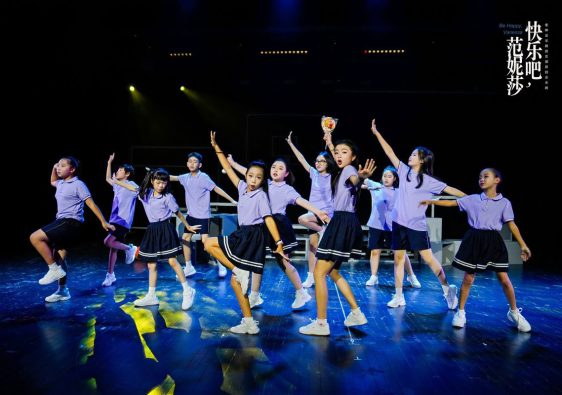
Our conversation with Director Gu began shortly after the “Be Happy, Vanessa” team was formed. Although the team was officially established and the script was ready, many still questioned why she chose to create a brand-new original youth musical without relying on a popular IP.
Gu often says this is a project she has long dreamed of doing. What I’ve always been curious about is: “Why?” Why, with so many well-known IPs available, would she take the risk of crafting a story with an uncertain future?
Born in Taiwan, raised in New Zealand, educated in the United States, and currently working primarily in Shanghai, Gu seems to carry influences from many countries. Yet she often says: “We must insist on creating original Chinese musicals, ones that we, the Chinese, truly love.”
—
About Gu Xiangping
Director and Playwright
A graduate of NYU’s Tisch School of the Arts, Gu is a professional playwright and director, specializing in musical theatre and immersive experiences. She is also active in commercial performances, with work spanning the arts, fashion, and business sectors. With over 20 years of experience, she has created more than 10 original musical and theatrical works, many of which have been staged at prominent venues such as Shanghai Culture Square, Shanghai Dramatic Arts Centre, Lyceum Theatre, and Theatre YOUNG.
—
Q: Why did you choose to create original musicals?
A: I’ve studied classical music since I was very young—over 20 years now. Later, I moved into theatre, so combining music with drama became a natural path for me.
While studying theatre performance at NYU, I became obsessed with musicals and watched a ton of them. At the time, Asia’s musical theatre industry had barely taken off.
In 2015, I wrote my first entirely self-penned musical in collaboration with Shanghai Animation Film Studio, using the *Black Cat Detective* IP. But even before that, I had nearly two decades of original theatre experience. So when I entered the musical theatre space, combining that experience with my passions gave me great confidence.
—
Q: What’s your view on the development of original musicals in China?
A: At first, we have to imitate—just like when learning calligraphy, tracing characters is essential. In the beginning, purchasing foreign IPs was an important learning phase for the industry. But that’s gone on for nearly a decade. The next step is urgent—we must develop our own IPs.
Only original musicals that align with Chinese tastes—whether cultural trends, current events, or values—can truly grow the industry. These works also help nurture the talent behind and in front of the stage. This is crucial and something I am committed to supporting and building.
—
Q: Why focus on the “teenage school” theme for an original musical?
A: While China has produced some outstanding musicals, there’s still a gap when it comes to works targeting teens. Internationally, we have *Matilda*, *School of Rock*, and *Dear Evan Hansen*—all hugely successful musicals centered on teenage characters.
But this genre is underdeveloped in China. Musical theatre is still a young industry here. Training programs only began to emerge in the past decade. Before that, there were hardly any musical theatre courses in universities, making it difficult to find age-appropriate teen performers.
To advance this industry, we need to introduce children and students to musical theatre early—show them what it is and inspire them to participate. That’s the only way to cultivate a mature and thriving musical theatre ecosystem.
—
Q: What will young performers gain from rehearsing “Be Happy, Vanessa”?
A: True musical theatre consists of three equal parts: acting, dancing, and singing—each representing about 30% of the performance. You can’t exclude any of them and still call it a proper musical.
Some people attempt “musical plays” that lean heavily on dialogue with limited music, but for me, that’s not real musical theatre. A true musical demands emotional expression through song, attitude through movement, and authenticity through acting.
During the creative process of *Be Happy, Vanessa*, kids learn to express emotions through singing, convey attitude through dance, and understand how to truly act. This experience is incredibly valuable. What makes it even more special is that the musical is in its creation phase. The children, students, and performers involved are becoming an essential part of the original team. A show’s creation phase only happens once.
—
Q: We know there are students from other cities involved in the production. How do you ensure they keep up with the training, and are you confident in their performance?
A: This time, we have students not only from Zhengzhou but also from Suzhou who travel to Shanghai for classes. Zhengzhou has a fantastic dance teacher. After our choreographer completes the dances in Shanghai, we send video tutorials to Zhengzhou, where the local teacher instructs the students and strictly monitors quality and progress.
Their dedication and focus put my mind at ease. I look forward to seeing them join the intensive training and believe they will quickly integrate into the team and deliver excellent performances.
There are talented kids all over China. My greater hope is that more children from various cities will have the chance to join this musical. These days, distance is no longer a barrier—technology, online platforms, and instant communication have made it possible to collaborate across regions.
—
Q: Why do you recommend that every child try learning musical theatre?
A: Musical theatre offers a comprehensive form of education. In other countries, kids don’t necessarily “learn” musical theatre—it’s embedded in the school curriculum. But since it’s not included in China’s standard educational framework, I encourage kids to watch more musicals, listen to them, and get involved to discover if they enjoy it.
It may not be for everyone, but it’s a powerful, integrated art form. It can help children make breakthroughs in music, dance, and dramatic expression. These are essential to a child’s emotional and personal growth.
—
Q: What inspired the creation of “Be Happy, Vanessa”?
A: Though this project officially launched in September last year, I’ve been developing the idea and script in my heart for 2–3 years.
My daughter is 15 this year. From ages 12 to 15, she went through an incredibly difficult phase, just like millions of other teens today—coping with academic pressure and the emotional turmoil of adolescence. It’s a time of unhappiness, sensitivity, and struggle.
So I wanted to write a play that speaks to teens, giving them a chance to express their emotions during this journey. That’s incredibly important to me.
I hope more and more kids will join this project. Through it, they can release their emotions. Right now, the mental health of children is what they need most—more than food, more than clothing. As adults, educators, and artists, this must be our top priority.
—
Q: With the premiere of *Be Happy, Vanessa* approaching, what should audiences look forward to?
A: In life, we may only get one or two chances to be parents, yet we have no margin for error. That’s incredibly difficult. Most of what we know about parenting comes from our own parents—whose guidance may no longer be relevant today.
Our generation grew up without the internet, smartphones, or social media. So now, we are parenting in uncharted territory. Often, we don’t get to hear what our children truly feel.
Through this musical, I hope to give parents a chance to **listen**—really listen—to what their children are saying. The world changes daily. We can’t keep imposing our own values on the next generation.
—
Q: Any final words for the audience?
A: Whether you come alone or with your children, I believe *Be Happy, Vanessa* will leave you with something to reflect on. As the director and writer, I hope to share the insights I’ve gained from years of observing the younger generation and experiencing parenthood. This show is born from those deeply personal moments, and I look forward to sharing that journey with all of you.